
EDITION NO. 07
Paul Klee, "Senecio" (1922)
Paul Klee painted Senecio (Soon to Be Aged) in 1922, during his influential years teaching at the Bauhaus in Germany. The work reduces the human face to a striking arrangement of geometric shapes, divided by bold lines and filled with warm reds, oranges, yellows, and softer neutral tones. Its mask-like appearance reflects Klee’s fascination with simplifying recognizable subjects into symbols, allowing color and form to carry as much meaning as the figure itself.
The title Senecio is particularly intriguing: the Latin word senex means “old man,” while Senecio is also the name of a flowering plant commonly known as groundsel. The alternate title, Soon to Be Aged, reinforces the painting’s connection to time and transformation. The face seems simultaneously youthful and aged, playful and solemn—an ambiguity typical of Klee’s work. Rather than creating a traditional portrait of a particular person, Klee presents a face that feels more like a shifting symbol of human identity, aging, and the passage of time.
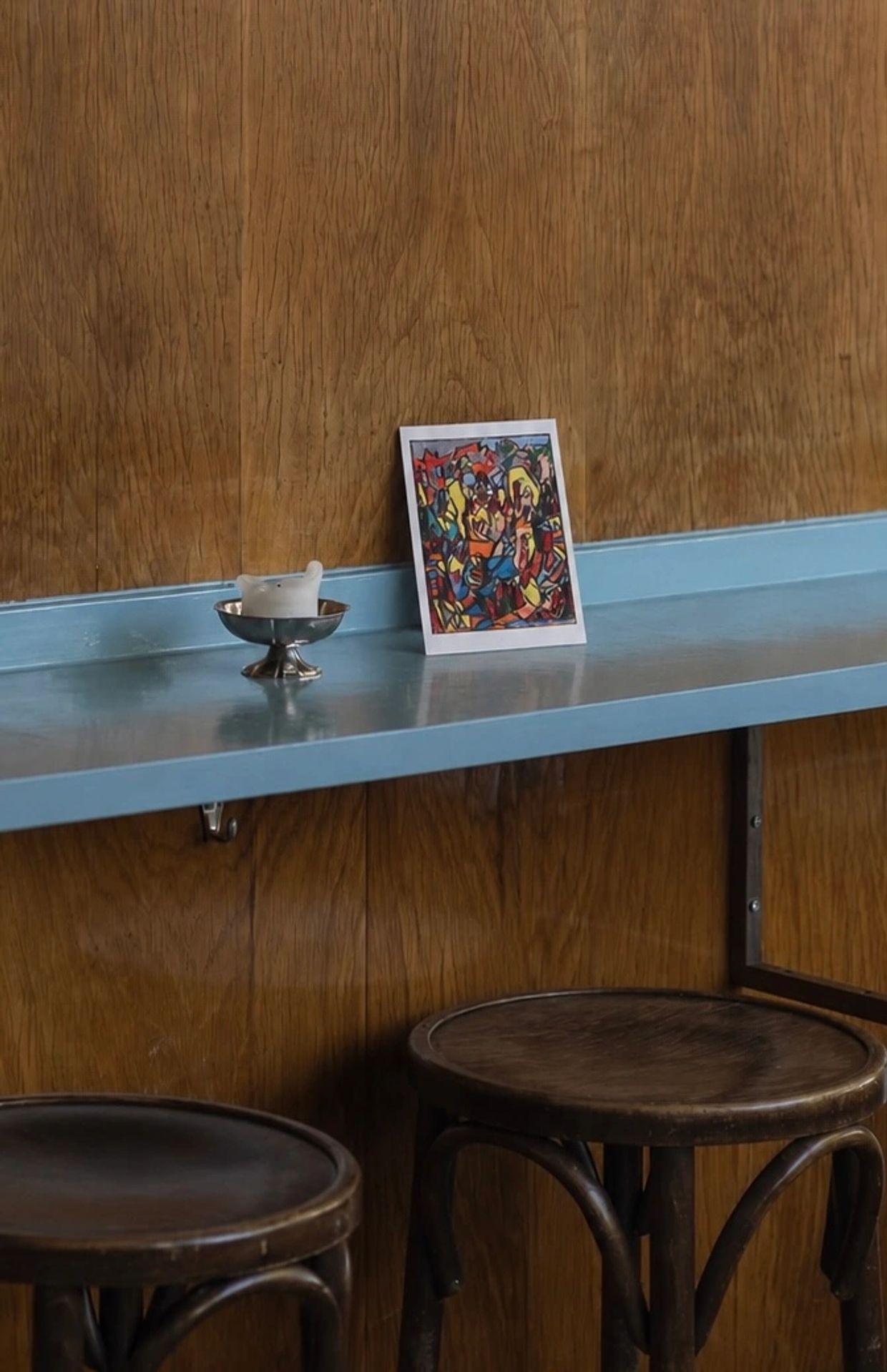
EDITION NO. 06
Adolf Hölzel, "Landscape with Figures" (1925)
Adolf Hölzel’s Landscape with Figures (1925) comes from the later period of an artist considered an early pioneer of abstraction in Europe. Moving away from traditional representation, Hölzel transformed landscapes and figures into arrangements of shape, line, and color, allowing recognizable forms to shift in and out of abstraction.
Hölzel was fascinated by the relationship between color and music, approaching composition almost as a musician might approach rhythm and harmony. His ideas also reached far beyond his own work: as a professor at the Stuttgart Academy, he taught future Bauhaus artists Johannes Itten and Oskar Schlemmer, helping influence the development of twentieth-century modernism.

EDITION NO. 05
Georges Valmier, "Still Life on a Table" (1911 - 1912)
Painted during the birth of Cubism, Still Life on a Table reflects the moment artists began breaking away from traditional perspective, reducing everyday objects into bold geometric forms. Rather than simply depicting a chair and table, Valmier invites us to see familiar objects from multiple viewpoints at once—an idea that forever changed the course of modern art.
This painting was created at nearly the same moment Pablo Picasso and Georges Braque were developing Analytic Cubism in Paris. While Valmier would later become known for vibrant geometric abstraction, this early still life offers a rare glimpse into his transition from traditional painting to one of the defining visual languages of the twentieth century.

EDITION NO. 04
Thorolf Holmboe, "Bird Motif" (1895-1914)
"Bird Motif" by Thorolf Holmboe (Norwegian, 1866–1935) was a Norwegian painter, illustrator, and designer associated with the Art Nouveau movement. He is especially admired for his decorative interpretations of nature, often depicting birds, marine life, and Nordic landscapes with flowing lines and stylized forms.
Bird Motif reflects Holmboe's fascination with the natural world and his ability to transform a simple bird study into an elegant ornamental design. The composition combines graceful movement with bold patterning, characteristic of Scandinavian Art Nouveau at the turn of the twentieth century.

EDITION NO. 03
Henry Lyman Saÿen, "Anemones" 1910-1912
Anemones (ca. 1910–1912) reflects Henry Lyman Saÿen’s shift from scientific training into early American modernism, blending structural brushwork with a soft, atmospheric palette. Painted during his time in Paris, the work shows the influence of Post-Impressionism and Cézanne, translating a simple floral subject into a study of form, rhythm, and color rather than strict realism.
EDITION NO. 02
Robert Delaunay, "Portrait De Madame Heim" 1926–27
Robert Delaunay was a pioneer of Orphism, a style that focused on color and rhythm rather than realistic form, and he often explored how color alone could create movement and emotion.
In "Portrait De Madame Heim" he blends portraiture with abstraction—something many people don’t realize—so while it appears decorative and geometric at first, it’s actually a stylized representation of a real person rather than a purely abstract composition.

Edition No. 01
Paul Klee, "Magic Garden" 1926
Painted in 1926 during his years teaching at the Bauhaus in Germany, Magic Garden represents one of Paul Klee’s most refined explorations of imagination structured through order.
Rather than depicting a literal landscape, Klee constructs a garden from symbols, color relationships, and rhythmic geometry. Small blocks of luminous color appear to grow organically across the surface, suggesting pathways, plants, architecture, and unseen life emerging simultaneously.
Klee believed art should not simply reproduce nature but reveal its inner logic. As he famously wrote:
“Art does not reproduce the visible; rather, it makes visible.”
In Magic Garden, the viewer moves through space almost like wandering at dusk — forms hover between abstraction and memory. The composition balances playfulness with precision, reflecting Bauhaus ideals where intuition and structure coexist.